
The Art of Opinion Writing
Transform your ideas into compelling opinion writing that cuts through the noise and makes an impact.
Modules/Weeks
Weekly Effort
Discipline
School
Format
Cost
Course Description
In a media landscape where anyone can broadcast an opinion, the ability to write one that truly matters has never been more important. Sharing a viewpoint is easy. Writing an opinion that gets published, read, and taken seriously is not.
The strongest opinion pieces do more than state what the writer thinks. They advance public debate, introduce new perspectives, and translate complex ideas into clear, persuasive arguments that resonate with broad audiences. When done well, opinion writing can challenge assumptions and shape how people understand the world.
This course is designed to help you do exactly that. Guided by Jelani Cobb, Dean of Columbia Journalism School and award-winning journalist, The Art of Opinion Writing teaches the craft behind impactful opinion pieces—how to choose a compelling subject, develop a focused argument, write with clarity and authority, and refine your work with an editor's eye.
Whether you work in law, medicine, public policy, education, technology, or any field where it's vital to share your knowledge or new ideas, this course offers a practical framework for bringing your expertise into public conversation. You'll learn how to write for general audiences without oversimplifying, how to balance persuasion with accuracy, and how to pitch your work to editors at leading publications.
Designed for academics, professionals, advocates, and emerging thought leaders, this course equips you with the skills and confidence to move beyond commentary and write opinions that can influence public discourse.
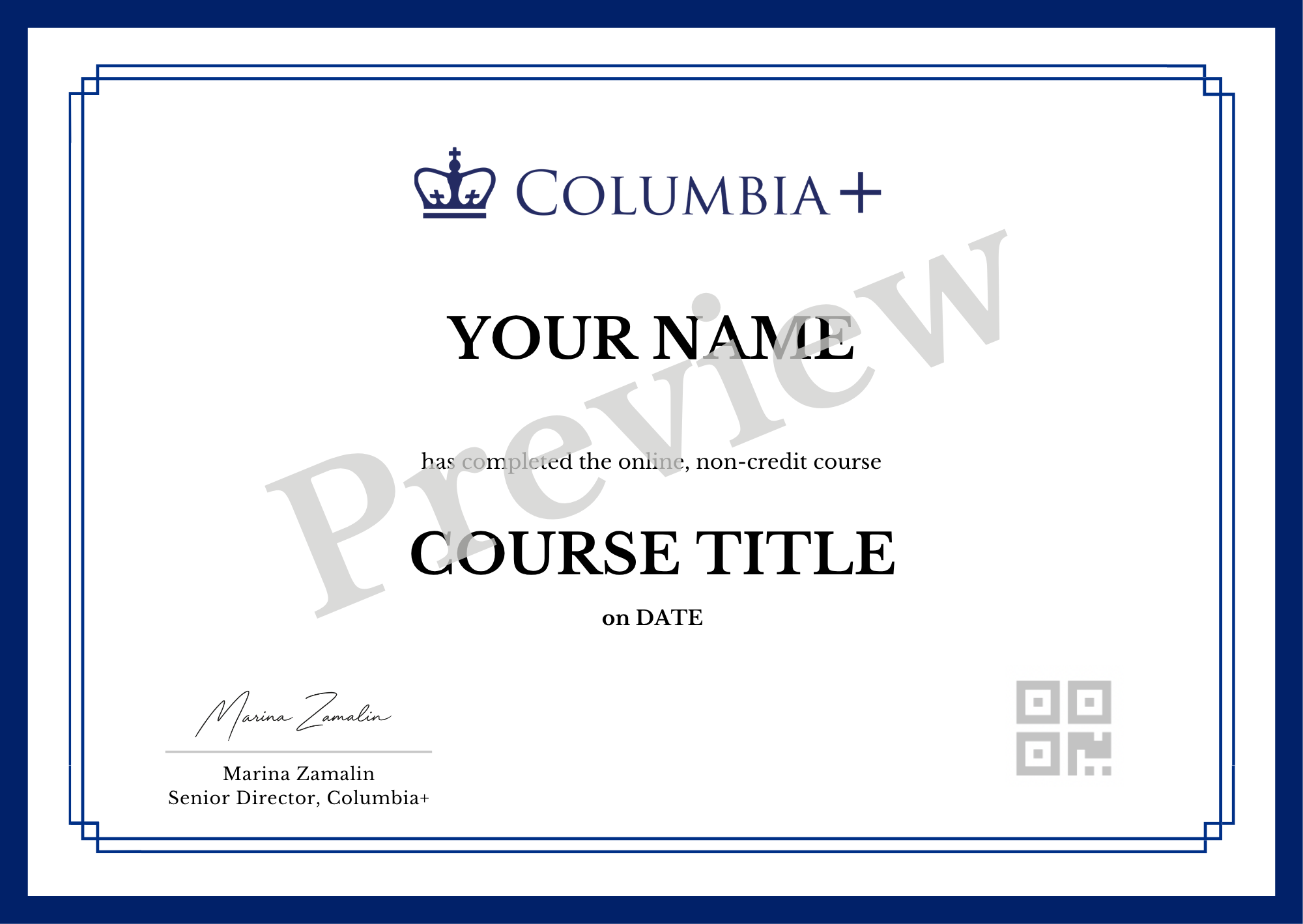
Learners who successfully complete all course requirements are eligible to earn a certificate of completion.
Note: Learners who enrolled through the WRITESUMMER26 promotion may purchase an optional certificate for $20 after completing the course.
Course Prerequisites
There are no prerequisites for this course.
A willingness to write, revise, and engage thoughtfully with your ideas is all you need to get started.
What You Get
1-year access to your course
Revisit content anytime for 1 year from the date you enroll.
Earn a certificate
Earn a Columbia+ certificate upon completion.
Global network of peers
Connect with like-minded learners from around the world.
Expert-led instruction
Learn from Columbia faculty and industry practitioners.
What You Will Learn
This course introduces the core skills behind effective opinion writing, helping you move from ideas to publishable arguments that resonate with editors and readers alike. By the end of the course, you’ll be able to:
- Distinguish opinion writing from academic writing, reporting, and other forms of prose.
- Identify the elements that make an opinion piece engaging, credible, and impactful.
- Construct a clear, persuasive argument in under 1,000 words.
- Analyze why certain opinion pieces resonate with editors and the public.
- Develop and deliver a professional pitch for an opinion piece.
- Module 1: The Art of Opinion Writing and Choosing Your Subject
This module introduces the fundamentals of opinion writing and guides you in selecting a timely, relevant, and compelling subject. You will learn how to identify what makes a piece an “opinion” and how to choose a topic that will resonate with editors and readers.
Learning Objectives:
- Define what an opinion piece is and distinguish it from other forms of writing.
- Identify qualities that make a topic suitable for opinion writing.
- Select a subject that aligns with both your expertise and current public conversations.
- Module 2: How to Start
Getting started is often the hardest part. In this module, you will explore strategies to overcome writer’s block, learn how to craft an attention-grabbing lede, and analyze examples of strong and weak openings.
Learning Objectives:
- Apply strategies for overcoming hesitation and beginning the writing process.
- Craft an effective lede that hooks the reader immediately.
- Evaluate examples of successful and unsuccessful openings to refine your own approach.
- Module 3: Perfecting Your Paragraphs
Opinion writing thrives on clarity and structure. This module focuses on building paragraphs that each serve a distinct purpose, creating a logical flow of ideas, and leaving the reader with a strong final impression.
Learning Objectives:
- Organize your argument by structuring your piece paragraph by paragraph.
- Define the purpose of each paragraph (“graf”) in advancing your overall argument.
- Write a memorable closing that strengthens your message.
- Module 4: Think Like an Editor: Polish & Refine
Editing is where good writing becomes great. This module introduces the mindset of an editor and practical techniques for refining your draft to make it concise, persuasive, and ready for submission.
Learning Objectives:
- Adopt an editor’s perspective to evaluate your own writing.
- Apply editing techniques to sharpen arguments, tighten language, and improve readability.
- Module 5: Think Like an Editor: The Pitch
Even the best opinion pieces need to reach the right audience. This module explains how to craft and deliver an effective pitch to editors, including the essential questions to answer and strategies to stand out.
Learning Objectives:
- Define what a pitch is and its role in opinion publishing.
- Address the key questions editors expect in a pitch.
- Apply additional techniques to make your pitch persuasive and professional.
Instructors

Jelani Cobb joined the Columbia Journalism School faculty in 2016 and became Dean in 2022.
He has been a staff writer at The New Yorker since 2015. He received a Peabody Award for his 2020 PBS Frontline film Whose Vote Counts? and was a finalist for the Pulitzer Prize in Commentary in 2018. He has also been a political analyst since 2019.
He is the author of Three Or More Is a Riot: Notes on How We Got Here: 2012-2025; The Substance of Hope: Barack Obama and the Paradox of Progress; and To the Break of Dawn: A Freestyle on the Hip Hop Aesthetic. He is the editor or co-editor of several volumes, including The Matter of Black Lives, a collection of The New Yorker’s writings on race, and The Essential Kerner Commission Report. He is a producer or co-producer on several documentaries, including Lincoln’s Dilemma, Obama: A More Perfect Union, Policing the Police, and The Riot Report.
Dr. Cobb was educated at Jamaica High School in Queens, NY, Howard University, where he earned a B.A. in English, and Rutgers University, where he completed his M.A. and doctorate in American History in 2003. He is also a recipient of fellowships from the Ford Foundation, the Fulbright Foundation, and the Shorenstein Center at Harvard University’s Kennedy School of Government.
He currently serves on the Board of Directors of the American Journalism Project and the Board of Trustees of the New York Public Library. He received an Honorary Doctorate for the Advancement of Science and Art from Cooper Union in 2022 and an Honorary Doctorate of Letters from Rutgers University in 2024. York College / CUNY and Teachers College have honored Dr. Cobb with medals.

Kate Kennedy is the Director of Professional and Academic Programs at Columbia Journalism School.
In this role, she develops and manages executive, continuing, and custom programs for those working in news and media. She joined the Journalism School after more than a decade in book publishing as an acquiring editor of narrative nonfiction, memoir, and literary fiction. She loves storytelling in all forms.