
Ages of Globalization
Explore seven ages of globalization and discover how geography, technology, and institutions have shaped our interconnected world and the challenges we face today.
Register for a free live webinar with Professor Jeffrey Sachs on November 5th at 8:00 AM ET.
Modules/Weeks
Weekly Effort
School
Format
Cost
Course Description
Global trade, technological disruption, geopolitical tensions, and climate change are reshaping our interconnected world. But the forces behind today's challenges have evolved over thousands of years. How did we get here, and what can history teach us about where we're headed?
In Ages of Globalization, Columbia University Professor Jeffrey D. Sachs takes you on a journey through seven ages of globalization, from the Paleolithic era to the Digital Age. Explore how geography, technology, and institutions have shaped human civilization, fueled progress, and driven conflict and inequality throughout history. Through historical examples, influential thinkers, and lectures filmed at iconic sites such as the Roman Forum and the Great Wall of China, you'll examine the rise and fall of empires, the expansion of global trade, and the evolution of political and economic systems. You'll connect these historical developments to today's shifting global order, from the emergence of a multipolar world to the challenges of climate change, sustainable development, and international cooperation.
The course combines self-paced online learning with two live online sessions with Professor Sachs.
Course Duration:
- October 16, 2026 - January 11, 2027
Enroll By:
- January 10, 2027
Live Online Sessions with Professor Sachs:
- December 2, 2026, at 9:00 AM ET
- January 11, 2027, at 8:00 AM ET
This Course Is Ideal For:
- Students and researchers in history, economics, political science, international relations, geography, environmental studies, and related disciplines.
- Professionals working in international development, sustainability, public policy, government, and global affairs.
- Leaders and decision-makers in NGOs, international organizations, and the private sector seeking historical context for today's geopolitical, economic, and sustainability challenges.
- Lifelong learners interested in world history, globalization, and the forces shaping our interconnected world.
By examining the historical forces behind today's global challenges, you'll better understand how our interconnected world evolved and gain a broader perspective on the choices that will shape its future.
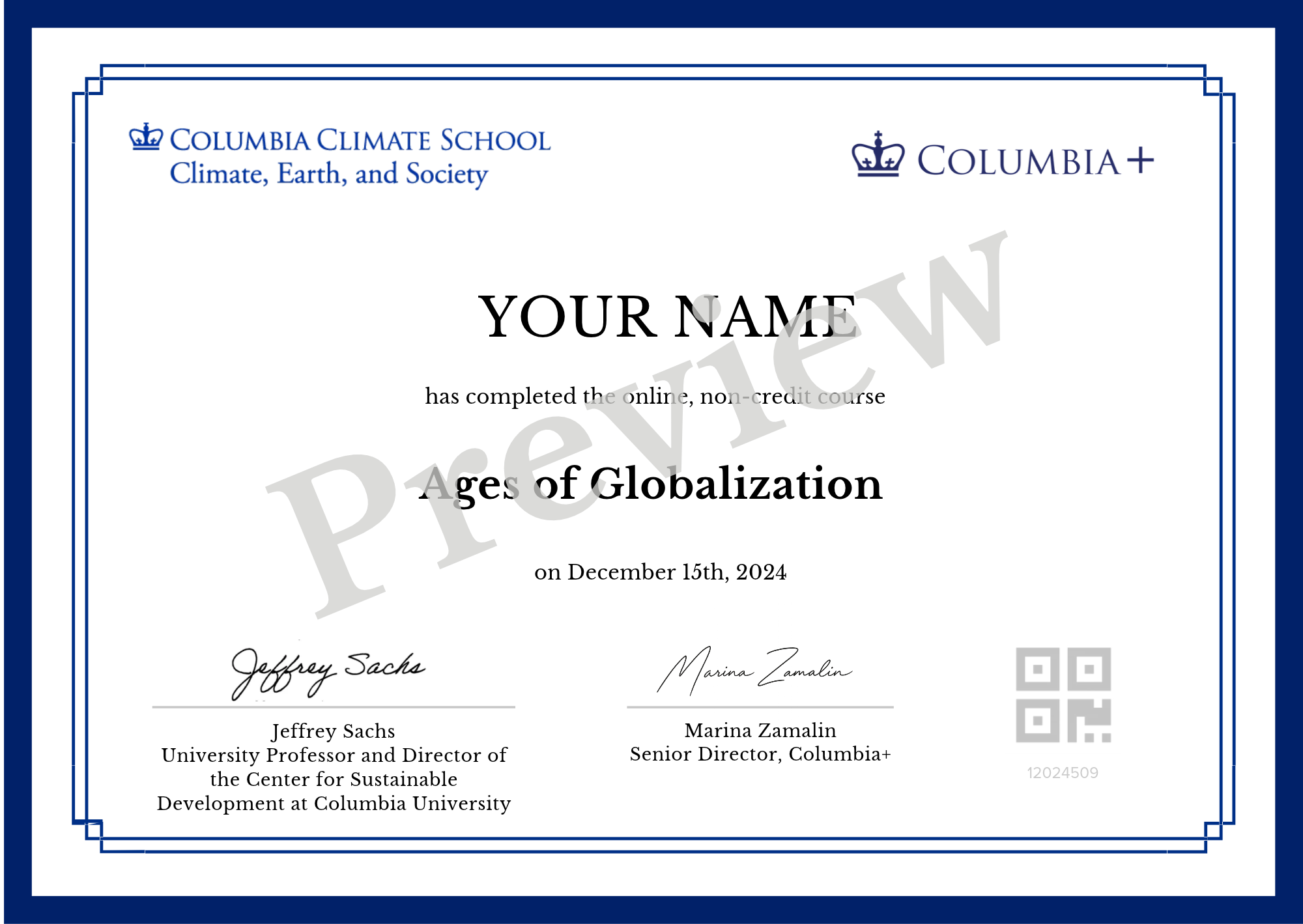
Learners who successfully complete all course requirements are eligible to earn a certificate of completion.
Course Prerequisites
This course has no prerequisites. Learners of all backgrounds and experience levels are welcome.
What You Get
Live sessions with Professor Sachs
Join two live, interactive online sessions to ask questions and engage directly with Columbia faculty.
1-year access to your course
Revisit content anytime for 1 year from the date you enroll.
Earn a certificate
Earn a Columbia+ certificate upon completion.
Global network of peers
Connect with like-minded learners from around the world.
Expert-led instruction
Learn from Columbia faculty and industry practitioners.
What You Will Learn
Journey through the seven ages of globalization, from early human societies to the Digital Age, and examine how geography, technology, and institutions have shaped civilizations throughout history. Connect these developments to today's geopolitical, economic, and environmental challenges, and gain a broader perspective on our interconnected world.
By the end of the course, you will be able to:
- Analyze Historical Change: Explain how geography, technology, and institutions have shaped civilizations across seven ages of globalization.
- Trace Shifts in Global Power: Examine the rise and fall of empires, Western expansion, and the emergence of today's multipolar world.
- Connect History to Current Challenges: Relate long-term patterns of globalization to climate change, inequality, geopolitical tensions, and technological disruption.
- Understand Sustainable Development: Explain the principles of sustainable development and the role of the United Nations Sustainable Development Goals (SDGs) in addressing global challenges.
- Evaluate Influential Ideas: Analyze historical texts, philosophical ideas, and international agreements to understand changing perspectives on governance and global cooperation.
- Module 1: The Seven Ages of Globalization
Discover how human civilization evolved from hunter-gatherer societies to today's interconnected digital world, guided by the interplay of geography, technology, and institutions.
- Identify the seven ages of globalization and their defining characteristics.
- Recognize the major transitions that transformed human societies and expanded connections between civilizations.
- Module 2: Geography – The Environment as Home and Shaper of Economy
Discover how geography has influenced where civilizations emerged, how economies developed, and how societies connected throughout history.
- Examine how climate, topography, natural resources, and disease patterns shaped human development.
- Understand how rivers, trade routes, and geographic barriers facilitated or constrained exchange between societies.
- Module 3: Technology – Two Million Years of Technological Advancement
Trace two million years of innovation, from early tools and infrastructure to industrialization and digital technologies, and their transformative effects on human civilization.
- Identify technological breakthroughs that reshaped economies and societies across historical eras.
- Explore how advances in transportation, communication, and infrastructure accelerated global interconnectedness.
- Module 4: Institutions and How We Live
Understand how political, economic, social, and religious institutions have evolved to shape the organization and functioning of human societies.
- Examine the roles of different institutions in governance, economic activity, and social relationships.
- Consider how institutional arrangements influence cooperation, competition, and interactions between societies.
- Module 5: Sustainable Development & SDGs
Explore the principles of sustainable development and the global effort to address poverty, inequality, and environmental challenges while advancing peace and prosperity.
- Understand the United Nations Sustainable Development Goals (SDGs) and their role as a shared framework for global progress.
- Examine the connections between economic prosperity, social inclusion, environmental sustainability, and peace.
- Module 6: The Rise of Empires in the Ancient World
Journey through the ancient empires of Asia, Europe, and the Middle East to understand how imperial expansion transformed governance, trade, and cultural exchange.
- Trace the emergence and expansion of major ancient empires.
- Examine their lasting contributions to political institutions, economic networks, and the exchange of ideas.
- Module 7: The Rise of Western Power after 1500
Investigate how European expansion, colonialism, and evolving political and economic institutions established centuries of Western global dominance.
- Trace the expansion of European colonial empires and global trade networks.
- Examine how colonial rule and emerging power structures shaped modern international relations.
- Module 8: From Western Dominance to Multipolarity – Post-1950
Examine how decolonization, changing economic relationships, and the rise of new global powers transformed the international order after 1950.
- Explore the political and institutional consequences of decolonization.
- Trace shifting centers of economic and geopolitical influence in an increasingly multipolar world.
- Module 9: The Sustainability Imperative
Confront the environmental challenges shaping humanity's future, from climate change and biodiversity loss to the urgent need for sustainable development.
- Examine the implications of climate change and biodiversity loss for global sustainability.
- Explore circular economy principles and potential pathways toward a more sustainable world by 2050.
- Module 10: The New Multilateralism
Consider how international cooperation, global institutions, and shared ethical principles can help address humanity's greatest challenges in the decades ahead.
- Examine how international institutions and multilateral cooperation can advance peace, justice, and sustainable development.
- Explore how global governance and shared ethical principles can inform responses to common challenges.
Instructors
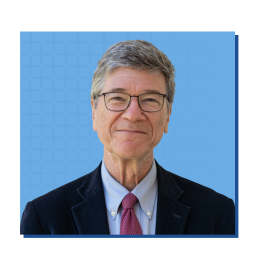
Jeffrey D. Sachs is a university professor and Director of the Center for Sustainable Development at Columbia University, where he previously directed the Earth Institute from 2002 to 2016. A globally recognized economist and leader in sustainable development, he has worked on economic development, globalization, international cooperation, and the world's most pressing sustainability challenges.
Professor Sachs is President of the United Nations Sustainable Development Solutions Network, Co-Chair of the Council of Engineers for the Energy Transition, Commissioner of the UN Broadband Commission for Development, and an academician of the Pontifical Academy of Social Sciences at the Vatican. He also serves as Tan Sri Jeffrey Cheah Honorary Distinguished Professor at Sunway University.
He has served as Special Advisor to three United Nations Secretaries-General and currently serves as an SDG Advocate under UN Secretary-General António Guterres. Before joining Columbia University, he spent more than two decades as a professor at Harvard University, where he earned his B.A., M.A., and Ph.D. degrees.
Professor Sachs has received 42 honorary doctorates and numerous international honors, including the 2022 Tang Prize in Sustainable Development, the Legion of Honor by decree of the President of the Republic of France, and the Order of the Cross from the President of Estonia.
A prolific author, his recent books include The Ages of Globalization: Geography, Technology, and Institutions (2020) and Ethics in Action for Sustainable Development (2022).